
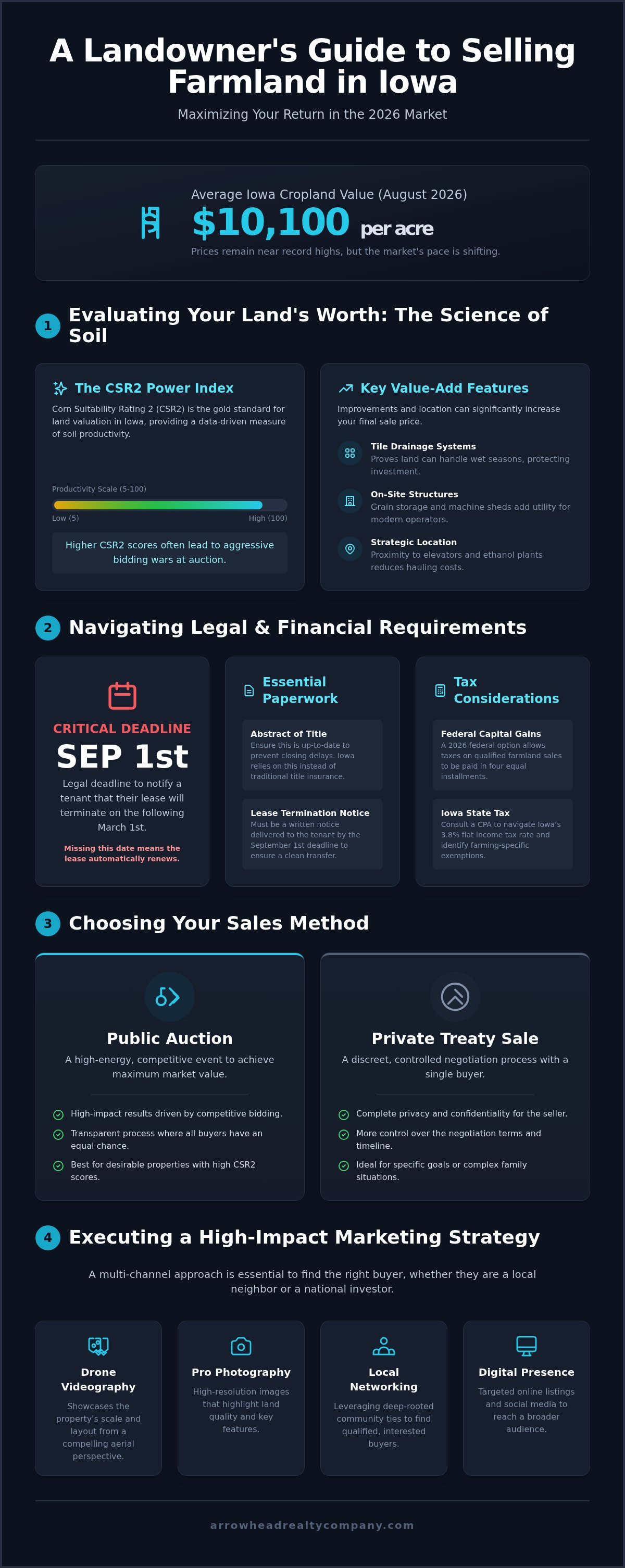
Did you know that as of August 2026, the average value of Iowa cropland has reached $10,100 per acre? While prices remain near record highs, the market's pace is shifting. This leaves many landowners wondering if now is the right time to transition or how to capture the best possible return.
You've likely spent decades pouring sweat and resources into your soil. It's natural to feel a bit of uncertainty when looking at 2026's complex land values and shifting tax codes. You want a sale that respects your family's legacy and also secures your financial future. We understand that this isn't just a transaction; it's a significant life milestone.
This guide provides the clarity you need on how to sell farmland in Iowa to ensure you don't leave money on the table or get caught in a legal tangle. We'll show you exactly how to maximize your price per acre using the latest market data and regional expertise.
We'll explore how to leverage CSR2 scores for top-tier pricing, navigate the new 2026 federal tax installment options for capital gains, and decide whether a high-energy auction or a discreet private sale fits your specific goals.
Key Takeaways
- Learn how CSR2 scores serve as the gold standard for land valuation and how to apply the 2026 market multiplier to your specific soil.
- Navigate critical timelines like the September 1st lease termination deadline to ensure your property is ready for a clean transfer.
- Discover how to sell farmland in Iowa by comparing the privacy of a private treaty sale with the high-impact results of a public auction.
- Master a multi-channel marketing approach that combines high-resolution drone videography with deep-rooted local networking to find the right buyer.
- Understand why local expertise in the Southwest Iowa market is essential for coordinating with attorneys and lenders to secure a smooth closing.
Evaluating Your Land's Worth: The Science of Iowa Soil and CSR2
Selling a farm isn't just about the total acreage; it's about the quality of the dirt beneath your feet. When you are investigating how to sell farmland in Iowa, the first thing savvy buyers will ask about is the soil's productivity. In the Hawkeye State, we measure this using the Corn Suitability Rating 2, or CSR2. This index is the gold standard for land value because it provides a uniform, data-driven way to compare one field to another across different counties.
In 2026, Southwest Iowa has seen a specific trend where the "multiplier" applied to each CSR2 point has shifted due to fluctuating commodity prices and global demand. While the state average sits around $10,100 per acre, your specific price depends heavily on your soil's rating. A professional Southwest Iowa land valuation is vital to your success. It helps you set a realistic reserve price by analyzing your mix of tillable acres, timber, and pasture. Tillable ground always commands the highest premium. However, timber and pastureland are increasingly valuable for recreational buyers or livestock producers, and they require a different valuation approach than row-crop acres.
Understanding the CSR2 Power Index
The CSR2 is a numerical index ranging from 5 to 100 that rates soil productivity based on inherent properties and typical weather patterns. Professionals use USDA soil maps to calculate a weighted average for your specific parcel, ensuring every acre is accounted for. In Page County, a high CSR2 score often triggers aggressive bidding wars at auction. Buyers know that better soil means better yields and lower input costs over the long haul. This rating stays with the land, making it the most stable indicator of long-term value you have at your disposal.
Identifying Value-Add Features
Beyond the soil itself, structural and infrastructure improvements can significantly bump your final sale price. Existing tile drainage systems are a massive asset. If you have updated drainage records, make them available; they prove the land's ability to handle wet springs and protect the buyer's investment. Grain storage facilities and machine sheds also add utility that many modern operators crave. Finally, don't overlook location. Being close to local ethanol plants or grain elevators in Shenandoah improves the "basis" for the buyer. This proximity reduces hauling costs and makes your productive agricultural land even more attractive to local neighbors and investors alike.
Navigating Legal and Financial Requirements for an Iowa Land Sale
Understanding the legal hurdles is just as important as knowing the market value of your dirt. When you are planning how to sell farmland in Iowa, your timeline is often dictated by state law rather than personal preference. It's helpful to stay grounded in the latest data, such as the Iowa State University Land Value Survey, but the paperwork is where the deal truly settles. One of the most critical dates on your calendar is September 1st. This is the legal deadline to notify a tenant that their lease will terminate on the following March 1st. If you miss this window, the lease automatically renews under the same terms; this can complicate a sale or deter buyers who want immediate possession.
You'll also need to prepare your abstract of title. Iowa is unique because we don't use traditional title insurance; instead, we rely on a comprehensive abstracting system and the Iowa Title Guaranty. Ensuring your abstract is up to date prevents frustrating delays during the closing process. Because tax laws are constantly shifting, such as the 2026 federal option allowing capital gains taxes on qualified farmland sales to be paid in four equal installments, consulting with a specialized agricultural CPA is non-negotiable. They can help you navigate Iowa’s 3.8% flat income tax rate and identify specific exemptions for farming businesses.
Managing Existing Farm Leases
To terminate a lease legally, you must deliver a written notice to the tenant by the September deadline. You have the choice to sell the land "subject to" the current lease, where the buyer takes over as the landlord, or provide full possession if the lease is properly ended. Investors often prefer the stability of cash rent leases, while local operators might look for a clean slate to expand their own production. If you're unsure where your property stands, reviewing your current lease agreements with a local expert can help you decide the best path forward for your specific parcel.
Tax Implications and 1031 Exchanges
The 1031 Exchange remains a powerful tool for Iowa sellers looking to preserve their wealth. By utilizing "Like-Kind" rules, you can defer capital gains taxes by reinvesting the sale proceeds into a new property. You have exactly 45 days from your closing to identify a replacement property and 180 days to complete the purchase. Many sellers in Page and Fremont counties are currently using these exchanges to transition from high-maintenance row-crop acres into recreational land for personal enjoyment or future legacy planning. This strategy keeps your capital working for you while aligning with your changing lifestyle goals.
Choosing Between Public Auction and Private Treaty Sales
Once you have evaluated your soil quality and cleared the legal hurdles, you must decide on the best sales method. This choice is central to how to sell farmland in Iowa effectively. You aren't just picking a format; you're picking a strategy to reach the right audience. In 2026, the market has fully embraced the 'Hybrid Auction' model. This approach combines the high energy of a live bidding floor with the global reach of online participation. Arrowhead Realty Company leverages United Country’s proprietary auction platforms to ensure your land is seen by local neighbors and out-of-state investors alike. Even in these fast-paced environments, you must still adhere to Iowa's legal disclosure requirements to ensure a transparent and legally sound transaction.
The Power of the Public Auction
Public auctions are the preferred choice for high-quality tillable land because they drive true "price discovery." In an open forum, competitive bidding often pushes the final price past initial market expectations. One major benefit is the auction contract itself. These are typically 'As-Is, Where-Is' agreements with no financing contingencies. This means the deal is firm the moment the gavel falls, providing you with immense peace of mind. The timeline is also incredibly efficient. After the initial 'Call for Bids' and a focused marketing period, you can usually expect a closing within 30 days. This speed is a massive advantage for sellers who want to move on to their next investment or settle an estate quickly.
When Private Treaty Makes Sense
While auctions are exciting, a private treaty sale offers total confidentiality and a slower, more deliberate pace. This is often the best route if you're selling to a neighboring farmer or a family member without public fanfare. It's also ideal for complex properties that include significant non-tillable acreage, timber, or residential components that might require a specific type of buyer. In a private sale, you maintain complete control over the final selection process. You can vet each offer individually and negotiate terms that go beyond just the dollar amount. This method allows you to find a buyer who truly respects the land's legacy while still achieving a fair market price. We often see this work best for multi-generational farms where the seller has a deep emotional connection to the property and wants to hand-pick the next steward of the soil.
Executing a High-Impact Marketing Strategy for Agricultural Land
Success in the 2026 market requires more than a sign in the ditch. When you are determining how to sell farmland in Iowa, your marketing strategy must bridge the gap between high-tech data and local relationships. Today's buyers are sophisticated. They want to see the land's potential before they even step foot on the property. We utilize high-resolution drone photography and videography to provide a bird's-eye view of topography and drainage patterns. This visual evidence is paired with detailed 'Sale Bills' that include everything a serious bidder needs: soil maps, FSA crop acreage records, and current tax information. By presenting this data upfront, we eliminate uncertainty and build immediate buyer confidence.
While digital reach is vital, we never ignore the power of the neighborhood. We launch targeted direct mail campaigns that reach every landowner within a 10-20 mile radius of your property. Often, the person most interested in your acres is the one already farming across the fence. This dual-track approach ensures that your land receives maximum exposure at both the local 'coffee shop' level and on a national scale.
Digital and Social Media Targeting
We tap into United Country's massive national database to connect your property with out-of-state investors who view Iowa dirt as a premier asset class. Our team also uses geofencing technology to deliver digital advertisements specifically to people attending local agricultural events and equipment auctions. It is essential to maintain mobile-friendly Iowa farmland listings so that active producers can review your property details directly from the tractor cab. This ensures your listing is always just a tap away for the most serious buyers.
Traditional Local Outreach
Physical presence still matters in Southwest Iowa. We place high-visibility signage at key intersections throughout Page and Fremont counties to capture local traffic. Our team draws on decades of experience in Clarinda and Shenandoah to identify potential buyers through established community networks. To facilitate the sale, we host informational 'Property Previews.' These events allow prospective bidders and their lenders to walk the land and ask technical questions in a relaxed, professional setting. If you're ready to put your land in front of the right audience, contact us today to start your custom marketing plan.
Partnering with Southwest Iowa Experts for a Seamless Closing
Managing the final stages of a transaction is where years of preparation finally meet the paperwork. When you are finalizing how to sell farmland in Iowa, the closing process requires a steady hand and deep local knowledge. In markets like Shenandoah and Clarinda, regional nuances can make a significant difference in your bottom line. We have seen how a lack of local context leads to "leaving money on the table," whether through overlooked drainage improvements or a misunderstanding of local buyer demand. Our team acts as the central hub for your entire transaction. We coordinate directly with attorneys to clear title issues, work with lenders to verify buyer funds, and manage surveyors to ensure legal boundaries are perfectly defined before any deed is signed.
The work doesn't stop once the gavel falls or the contract is signed. We facilitate final walkthroughs and manage the critical transition of Farm Service Agency (FSA) records. This ensures that crop bases and program participations are correctly transferred to the new owner, preventing administrative headaches during the next growing season. Arrowhead Realty’s dual expertise in both live and online auctions allows us to build a customized exit strategy. We don't believe in a one-size-fits-all approach. Instead, we tailor the closing timeline and the sales method to fit your specific financial goals and family needs.
The Arrowhead Realty Advantage
Our roots in the Southwest Iowa community run deep. We understand the agricultural landscape because we live and work here every day. This isn't just about moving property; it's about providing personalized service that treats your family’s land with the respect it deserves. We have built a proven track record of successful land auctions in Page County by combining traditional values with modern efficiency. You can trust that your legacy is in capable hands, from the first soil map we pull to the final handshake at the closing table.
Next Steps: Starting Your Land Sale Journey
If you are ready to explore the possibilities for your property, the first step is gathering accurate data. We offer a free, confidential market analysis of your acreage to help you understand exactly where you stand in the 2026 market. We will sit down with you for an initial consultation to discuss your specific goals, tax considerations, and preferred timeline. There is no obligation, just honest advice from local experts who care about your success. Contact Arrowhead Realty Company to begin your farmland sale today!
Secure Your Legacy and Maximize Your Land's Potential
Selling your family's farm is a monumental decision that requires more than just a handshake; it demands a data-driven strategy. By mastering the nuances of CSR2 scores and staying ahead of the September 1st lease termination deadline, you position yourself for a successful transaction. Whether you choose a high-energy auction or a discreet private sale, the right approach respects both your land's history and its future value. Your property represents years of hard work, and it deserves a closing that reflects that dedication.
Navigating how to sell farmland in Iowa in 2026 doesn't have to be overwhelming when you have a trusted partner by your side. At Arrowhead Realty Company, we combine deep expert knowledge of Page and Fremont counties with extensive national marketing reach. Our specialists excel in both live and online auction formats, ensuring your property gets the attention it deserves from local neighbors and global investors alike.
We're here to help you move forward with confidence and clarity. Your soil has worked hard for you for years; now it's time to ensure it provides the retirement or legacy you've earned!
Frequently Asked Questions
When is the best time of year to sell farmland in Iowa?
The best time to sell is typically between November and March. This window aligns with the end of the harvest and the start of the next planting season when buyers have a clearer picture of their annual income. Selling during this period avoids disrupting active farming operations, making it the ideal time for a smooth transition of possession and planning for the coming crop year.
How do I calculate the CSR2 score for my specific farm?
You can find your CSR2 score through the USDA Web Soil Survey or by requesting a professional valuation. While online tools provide raw data, a weighted average must be calculated for your specific parcel boundaries. We use these precise soil maps to determine the productivity of every acre. This ensures you have an accurate benchmark before you begin the process of how to sell farmland in Iowa.
Do I have to terminate my farm lease before I can sell the land?
You don't have to terminate a lease to sell, but it significantly changes your pool of potential buyers. Selling "subject to" an existing lease appeals to investors looking for immediate rental income. However, local farmers often prefer "full possession" for the next crop year. If you want to provide possession, you must deliver a formal termination notice to your tenant by the September 1st deadline.
What is the difference between a live auction and an online land auction?
A live auction features an in-person gathering with a fast-paced bidding environment, while an online auction allows bidders to participate from anywhere over several days. Live events create intense local competition and immediate results. Online platforms expand your reach to out-of-state investors who can't travel. We often recommend a hybrid model to capture both the energy of the room and the convenience of digital bidding.
How much are the closing costs when selling land in Iowa?
Sellers typically pay for the abstract update, deed preparation, and the Iowa real estate transfer tax. As of 2026, the transfer tax rate is $1.60 for every $1,000 of the sale price, with the first $500 exempt. You'll also need to account for professional brokerage fees and any property taxes prorated to the date of closing. These costs are usually deducted directly from your sale proceeds at the finish.
Can I sell my Iowa farmland if it is currently in a CRP program?
Yes, you can sell land currently enrolled in the Conservation Reserve Program (CRP). The buyer must either agree to assume the remaining contract terms or you must pay a buyout penalty to the FSA. Most buyers are happy to take over CRP contracts because they provide guaranteed annual income. It's vital to have your specific contract details ready for review during the marketing phase to avoid surprises.
What documents do I need to gather before listing my farm for sale?
You should gather your current deed, the most recent property tax statement, and any existing farm lease agreements. Detailed FSA maps, 156-EZ forms, and tile drainage records are also essential for tillable ground. If you have recent soil test results or yield history, these documents add significant value. Having this paperwork organized early prevents delays once you decide how to sell farmland in Iowa.
How long does the typical farmland sale process take from listing to closing?
The typical process takes between 60 and 90 days from the initial listing to the final closing. This timeframe includes about 30 to 45 days of intensive marketing followed by a 30-day closing period after the contract is signed. Auctions often provide a more predictable timeline than private treaty sales. We work closely with all parties to ensure the paperwork moves quickly and the transition is seamless.


