
What if the biggest surprise at closing isn’t the down payment, but who’s responsible for the other charges? Understanding closing costs in Shenandoah IA starts with separating these expenses from the down payment and checking how the property and purchase agreement affect the final amount.
It’s reasonable to want a clear estimate before you reach the closing table, especially when statewide averages may not reflect your transaction. In Iowa, some costs are tied to buyer financing, while others may be assigned by law or negotiated in the contract. Property tax prorations and transfer-related charges can also affect the final figures.
This guide explains common buyer and seller cost categories, Iowa-specific details that may shape them, and transaction terms that can change who pays. You’ll also find practical ways to compare estimates with closing documents. Whether you’re buying or selling in Shenandoah or nearby Clarinda, understanding the agreement and the property details can help you prepare for the costs ahead.
Key Takeaways
- Separate transaction charges and closing adjustments from your down payment and ongoing homeownership expenses.
- Compare costs commonly associated with buyers or sellers with the responsibilities written into the contract.
- Understand how Iowa title work, property tax prorations, and property records can affect closing figures.
- Use understanding closing costs in Shenandoah IA to prepare focused questions and organize details for an estimate.
- Compare preliminary estimates with final documents, then review your expected payment or sale proceeds before closing.
What closing costs mean for a Shenandoah, Iowa home sale or purchase
The purchase price is the agreed value of the property. The down payment is the portion a buyer pays upfront toward a financed purchase. Closing costs are separate: they are transaction charges, prepaid items, and adjustments settled when the sale is finalized. Moving expenses, repair costs, and future mortgage payments are also separate, even if they belong in your overall budget.
That distinction matters because a statewide percentage is only a starting point, not a quote for a specific Shenandoah or Clarinda transaction. Estimates may include different charges or assumptions, while the actual total depends on financing, property details, contract terms, and the services needed to complete the sale. Closing costs can include charges for both buyers and sellers, but no single list applies to every transaction.
Which expenses count as closing costs?
Common categories include financing charges, title and settlement services, recording charges, prepaid items, and prorations. A buyer using a mortgage may have loan-related costs, while a cash purchase generally won’t include charges tied specifically to arranging a loan. Which other items apply, and who pays them, depends on the transaction and written agreement.
- Financing: Charges connected to a buyer’s mortgage, when financing is involved.
- Title and settlement: Services and documents involved in reviewing ownership records and completing the transfer.
- Recording: Charges associated with filing transaction documents in public records.
- Prepaid items and prorations: Expenses paid in advance or divided between buyer and seller based on the closing details.
These categories help organize an estimate; they don’t mean every buyer or seller will pay every type of charge. Keep moving costs, agreed repairs, and ongoing ownership expenses separate when planning the funds you’ll need.
Why Shenandoah property details can affect the estimate
Location affects which county records and property details need review. A property’s mailing address alone may not tell the whole story, particularly around cities near county boundaries. Use the parcel information and legal description to identify the correct county for records and transaction review. This is one reason a statewide estimate can differ from the figures for an individual property in Shenandoah or Clarinda.
For broader context on the area and its housing, explore the Shenandoah homes and local living guide. For a more useful estimate, gather the property and financing details, then compare itemized charges with the purchase agreement. Understanding closing costs in Shenandoah IA means looking at the actual parcel and transaction, not relying on a percentage alone.
Iowa closing costs by buyer and seller: what each side may pay
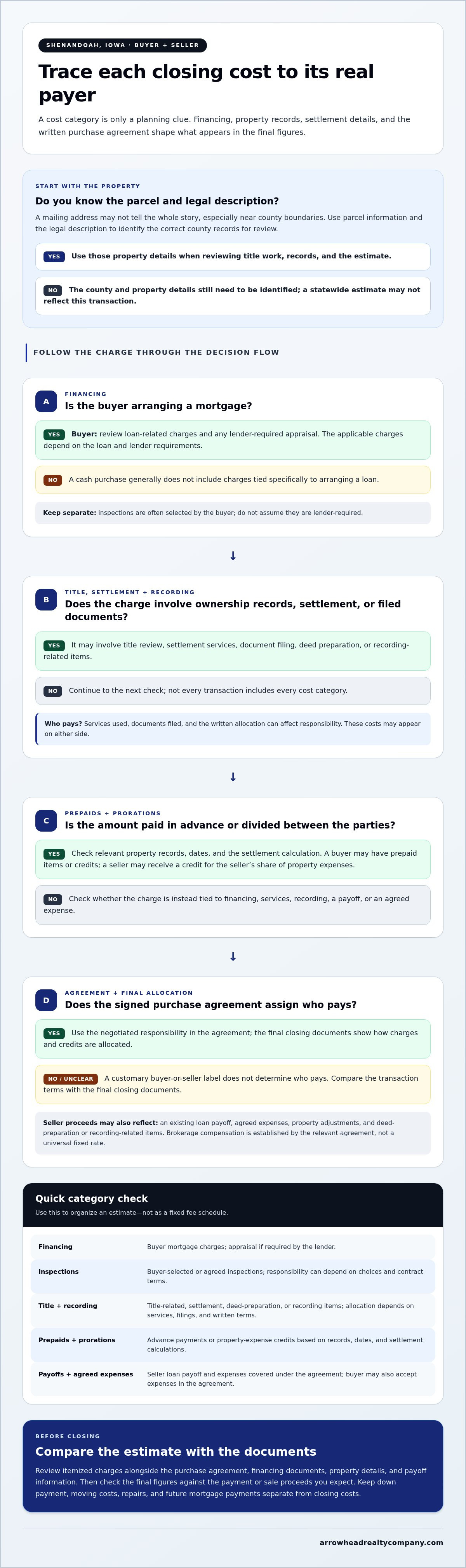
Some costs are commonly associated with one side of a sale, but the label doesn’t determine who pays. The purchase agreement sets out negotiated responsibilities, and the final closing documents show how charges and credits are allocated. Cornell Law School’s legal definition of closing costs offers general context; your transaction documents establish the actual details.
Use this comparison as a planning guide, not a fixed fee schedule. A charge may not apply to every purchase or sale, and the parties can agree to different arrangements where permitted.
| Cost category | Buyer considerations | Seller considerations | What can affect responsibility |
|---|---|---|---|
| Financing and appraisal | Loan-related charges and a lender-required appraisal, if applicable | Usually not a seller loan cost for the buyer’s financing | Whether the buyer finances, lender requirements, and loan terms |
| Inspections | Inspection costs the buyer chooses or agrees to arrange | Agreed repair or transaction expenses, if any | Inspection choices, contract terms, and negotiations |
| Title, settlement, and recording | Possible title-related, settlement, or recording charges | Possible deed-preparation or recording-related items | Services used, documents filed, and written allocation |
| Prepaids and prorations | Prepaid items or credits assigned to the buyer at closing | Possible credits for the seller’s share of property expenses | Relevant records, dates, and the settlement calculation |
| Payoffs and agreed expenses | Expenses the buyer accepts under the agreement | Existing loan payoff and expenses the seller agreed to cover | Payoff statements and contract language |
Closing-cost categories buyers may encounter
If you’re financing, review the lender’s itemized charges and note which costs depend on your loan terms. Title-related work, prepaid items, and recording charges may also appear. An appraisal may be required for the loan, while inspections are often selected by the buyer and shouldn’t be assumed to be lender-required. Compare the estimate with your purchase agreement and financing documents to identify which charges apply to your purchase.
Closing-cost categories sellers may encounter
A seller’s proceeds may be reduced by a loan payoff, agreed expenses, or property-related adjustments, including prorations. Deed preparation and recording-related items may also appear in the closing figures. Brokerage compensation is established by the relevant agreement; it isn’t a universal fixed rate. Review the estimated proceeds alongside the signed terms and payoff information.
For buyers and sellers, the practical rule is to compare each line item with the agreement and final documents. Check the description, amount, and party responsible for each charge, then follow up on any unfamiliar entry. A local real estate professional can help you understand transaction steps and contract terms. Explore Arrowhead Realty Company’s real estate representation for your Shenandoah or Clarinda sale or purchase.
How Iowa title work, taxes, and contract terms shape closing costs
A preliminary estimate is a working snapshot, not a promise of the final amount. As title and property records are reviewed, financing details are confirmed, and contract terms are applied, line items or allocations may change. A closing-cost estimate depends on property records, financing, and written agreements. Keep that principle in mind when understanding closing costs in Shenandoah IA and setting expectations for your transaction.
What an abstract of title and title review help establish
An abstract of title is a record history of a property, drawing together documents related to ownership over time. In Iowa, title review may involve examining that history and other recorded records to identify interests or issues relevant to transferring ownership. The documents and steps involved depend on the property and transaction, so don’t assume a particular process or charge applies to every Shenandoah or Clarinda sale.
Use an estimate to see what title-related work it anticipates, then compare it with the final itemized charges. If the property description, recorded ownership information, or other records require additional review, the figures may need updating. Check unfamiliar title or settlement line items against the transaction details and the final statement.
How taxes, recording, and negotiated terms affect the final figure
Property tax prorations allocate an expense between the parties based on the relevant period and closing details. Iowa taxes are paid in arrears, so the calculation can involve records for taxes that have accrued but are not yet paid. The closing date, tax information, and applicable records affect the adjustment shown on the closing statement. Confirm the property’s county and use its current records rather than relying on a statewide estimate.
Deed, recording, and settlement charges also need transaction-specific review. The document being filed, the property’s location, and the services involved can affect whether a charge applies and how it is calculated. Compare the applicable county information with the recording charges shown in the closing documents.
Written terms can change who bears an eligible expense. For example, a negotiated seller concession may shift some agreed costs to the seller, subject to the contract and any applicable financing terms. Iowa’s real estate transfer tax is another allocation to review: state law makes the buyer responsible, but the parties may negotiate payment, and sellers commonly pay it. Check the signed agreement and final statement to see how the transaction handles it. A local real estate professional can help you follow the contract terms and transaction steps as the estimate becomes final.
How to estimate and review closing costs before closing in Shenandoah
A useful estimate starts with the details of your transaction, then becomes more precise as financing, services, and property information are confirmed. For understanding closing costs in Shenandoah IA, follow the figures from early estimates to the final closing statement rather than relying on a single total.
What to gather before estimating your closing costs
Pull together the purchase agreement, financing information if you’re taking out a loan, available written estimates, and the property’s identifying details. Note any negotiated concessions or unusual circumstances, such as acreage or multiple parcels, that could affect the records or services involved.
For a Shenandoah or Clarinda property, confirm the parcel’s county before reviewing local records or recording-related charges. A city address isn’t a substitute for the property’s legal description or parcel information.
How to compare an estimate with final closing documents
Review the estimate and final statement side by side, matching entries by category instead of comparing only the bottom-line total. An item may change because a service was confirmed, loan details were updated, or the closing date affected a proration. A revised amount doesn’t automatically mean an error, but each difference should be understandable.
- Identify who pays: Compare the responsible party shown on the statement with the purchase agreement.
- Check the type of charge: Note whether it’s a service charge, prepaid item, payoff, or time-based proration.
- Review the basis: For a prorated expense, look for the relevant dates and records used in the calculation.
- Track changes: Compare updated loan-related entries, settlement or recording charges, and contract allocations with earlier documents.
Keep written estimates and updated statements together so you can track changes and identify questions before signing. If an entry is unfamiliar, compare it with the relevant contract term, estimate, or property record rather than assuming it’s included in another charge.
For local guidance with the real estate transaction and its contract terms, learn about Arrowhead Realty’s help with Shenandoah-area sales and purchases.
Plan your Shenandoah closing with clear cost expectations and local guidance
Clear expectations come from three habits: use itemized estimates, verify property details, and follow the signed agreement. As you build your plan, keep the down payment separate from other funds due at closing, and treat early figures as estimates until the transaction details are finalized. Understanding closing costs in Shenandoah IA is easier when you track what each line covers and who is responsible for it.
A practical checklist for buyers and sellers
Start with the documents that connect the estimate to your specific transaction. Keep the purchase agreement, current estimates, property information, and updated closing documents together so you can follow changes and find the written terms behind each allocation.
- Buyers: Separate the down payment from other closing funds. If you’re financing, compare loan-related estimates with the latest lender information, and check how any negotiated concessions appear in the documents.
- Sellers: Review expected proceeds after payoffs and agreed expenses. Check property tax prorations, other adjustments, and the payoff information used to calculate the remaining proceeds.
- Both parties: Confirm the property details and relevant county records, then compare each closing statement line with the signed agreement. Resolve unexplained changes before signing.
A changed figure deserves a clear explanation, especially if it affects the amount you need to bring or the proceeds you expect to receive. Check the calculation or allocation against the supporting documents.
Get local help with your Shenandoah real estate transaction
A local real estate representative can help you follow transaction steps, connect charges to the written contract, and understand how negotiated terms affect the sale or purchase. Arrowhead Realty represents clients in Southwest Iowa real estate transactions, including residential, commercial, farmland, and recreational property transactions. Its role is real estate representation, not lending or legal advice.
The Shenandoah relocation and real estate FAQ offers additional local context. For help with buying or selling in Shenandoah or Clarinda, connect with Arrowhead Realty to discuss your real estate transaction and next steps.
Move toward closing with a clearer plan
Understanding closing costs in Shenandoah IA starts with looking beyond a statewide estimate. The charges that apply, who pays them, and the final amount depend on financing, property records, prorations, and the written purchase agreement. Keep itemized estimates alongside your contract, and review the final documents line by line so changes don’t catch you off guard.
Buyers can prepare by separating closing funds from the down payment and reviewing loan-related estimates. Sellers can focus on projected proceeds, payoff information, prorations, and agreed expenses. In either case, local property details and contract terms help turn broad cost categories into a transaction-specific picture.
Arrowhead Realty serves residential buyers and sellers across Southwest Iowa, with regional knowledge spanning residential, commercial, farmland, and recreational transactions. If you’re planning a Shenandoah or Clarinda purchase or sale, talk with Arrowhead Realty about your local real estate plans. A well-organized review and local guidance can help you move toward closing with confidence.
Frequently Asked Questions
How much are closing costs in Shenandoah, Iowa?
There isn’t one total that applies to every Shenandoah transaction. The amount depends on the property, financing, services involved, and written contract terms, so a statewide average can’t predict your costs. To understand closing costs in Shenandoah IA, review an itemized estimate and note which charges it includes. Confirm the parcel’s county, too, since local records or charges may vary. Compare current figures with the closing documents as the transaction progresses.
Who usually pays closing costs in Iowa, the buyer or the seller?
Both buyers and sellers may have closing expenses, and the agreement determines how applicable costs are allocated. Buyers may see loan-related charges or prepaid items, while sellers may have prorations, payoff amounts, or expenses agreed to in the contract. Don’t assume a particular fee always belongs to one side. Review the purchase agreement alongside the closing statement and resolve any charge that appears inconsistent with the written terms.
What closing costs do buyers pay when purchasing a home in Iowa?
Depending on the purchase, buyers may encounter loan charges, appraisal or inspection expenses, title-related work, recording charges, and prepaid items. A financed purchase can include loan-related costs that don’t apply in the same way to a cash purchase. Not every buyer pays every type of charge. Use an itemized estimate to identify applicable costs, whether a service is required or optional, and how each amount was determined.
What closing costs do sellers pay in Iowa?
Seller expenses may include property-related prorations, deed or recording-related charges, loan payoff amounts, and expenses assigned to the seller in the purchase agreement. The specific deductions depend on the property and transaction. Review the estimated proceeds against payoff information and agreed terms, then compare them with the final settlement statement. If a deduction is unfamiliar or changes, check its basis in the supporting documents before signing.
Are Iowa closing costs negotiable?
Some eligible expenses or their allocation may be negotiated if the parties agree and the contract allows it. Other charges may depend on services used, financing terms, or applicable requirements, so don’t assume every fee can be changed. If the parties agree on a seller concession or another cost-sharing arrangement, make sure the term appears in writing. Review the updated estimate and compare it with the signed agreement and financing documents.
When will I know my final closing costs?
You can review preliminary estimates during the transaction, but final figures may change as financing, title work, prorations, and other details are confirmed. Before closing, compare the final statement with earlier estimates and the signed purchase agreement, checking both the line items and who pays them. If a charge differs or its calculation isn’t clear, review the supporting details before completing the transaction.
Does every Shenandoah property have the same Iowa closing costs?
No. Costs can vary with purchase price, financing, property records, services, timing, and negotiated terms. For homes in Shenandoah or nearby Clarinda, confirm the parcel’s county before reviewing local records or applicable charges. Online averages offer general context, not a property-specific quote. Use an itemized estimate based on the actual parcel and transaction, then compare it with the purchase agreement and updated closing documents as details are finalized.


