
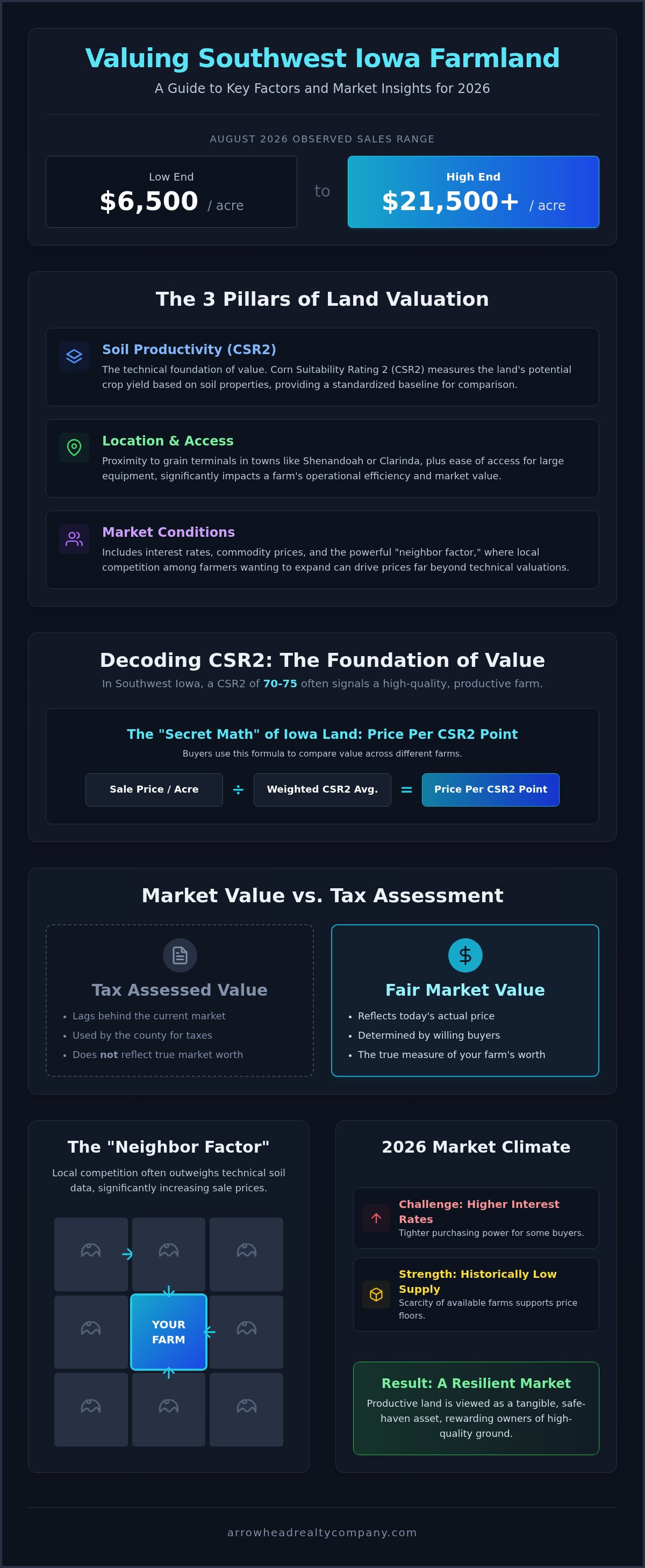
In the first week of August 2026, Iowa farmland sales saw a staggering range from $6,500 to over $21,500 per acre. If those numbers feel miles apart, it's because a statewide average rarely helps you determine exactly what is my farmland worth in Southwest Iowa today. You might find yourself staring at your CSR2 maps and wondering why a similar tract down the road commanded a much higher price. Perhaps you're also worried that shifting interest rates have cooled the demand for your dirt. It's a common concern because nobody wants to leave money on the table after decades of stewardship.
We understand that your land is more than just a legal description. It's your legacy and your largest asset. This guide will help you navigate the current market by looking at the specific factors buyers are prioritizing in our local corner of the state. You'll discover how neighbor-to-neighbor demand often outweighs technical soil data and learn the specific steps to determine a value that reflects the true potential of your property. We'll walk through the latest sales data from Fremont and Harrison counties, the reality of CSR2 point values, and the professional path to obtaining a detailed market report for your acreage.
Key Takeaways
- Understand how Corn Suitability Rating 2 (CSR2) serves as the technical foundation for soil productivity and baseline pricing in the region.
- Discover why the "neighbor factor" and local competition can significantly increase sale prices beyond what soil maps suggest.
- Learn the practical steps to calculate what is my farmland worth in Southwest Iowa by evaluating your farm's net tillable acreage.
- Distinguish between assessed value and fair market value to ensure you are positioned correctly for a successful sale or transition.
- Explore how professional market reports and advanced auction methods can maximize your property's exposure to both local and national buyers.
Understanding the Basics of Southwest Iowa Land Valuation
Determining what is my farmland worth in Southwest Iowa starts with understanding that valuation is a blend of scientific data and local sentiment. Valuation is the estimated market price a willing buyer pays a willing seller, rooted deeply in the land's ability to produce a consistent crop. While Northwest Iowa often sees higher sticker prices due to flatter topography, Southwest Iowa markets are intensely localized and influenced by our unique agriculture-based economy. Values here aren't universal; they fluctuate based on how a specific tract fits into the local landscape.
To get an accurate picture, you have to look at the three pillars of value:
- Soil Productivity: This is the technical foundation, typically measured by the CSR2 scale.
- Location and Access: Proximity to grain terminals in towns like Shenandoah or Clarinda, along with ease of equipment access, plays a massive role.
- Market Conditions: This includes everything from current interest rates to the "neighbor factor," where local competition drives prices beyond what the soil maps suggest.
Market Value vs. Tax Assessment
It's a common mistake to look at a property tax statement and assume it reflects real-world worth. Your tax assessment is a figure generated by the County Assessor to distribute the tax burden fairly across the county. It often lags behind the actual market by several years. In contrast, fair market value is what happens when the gavel falls at an auction today. Because the 2026 market moves rapidly, these assessments rarely keep pace with the premium prices buyers pay for high-quality tillable ground. Relying on tax data alone is a fast way to leave money on the table when asking what is my farmland worth in Southwest Iowa.
The 2026 Southwest Iowa Economic Climate
The current year has brought a specific set of challenges to the region. Higher interest rates have naturally tightened the purchasing power of some buyers, yet the supply of available farms remains historically low. This scarcity supports price floors even when commodity prices for corn and soybeans face volatility. Many investors still view Southwest Iowa dirt as a safe haven asset. They recognize that while paper wealth can shift overnight, productive land remains a tangible, finite resource that anchors regional wealth. When you combine limited inventory with steady demand from local operators, the result is a resilient market that rewards high-quality land owners.
Decoding CSR2: The Foundation of Iowa Farmland Value
If you want to know what is my farmland worth in Southwest Iowa, you have to look beneath the surface. CSR2 is an index that predicts crop yield potential based on soil properties. It's the technical benchmark used across the state to level the playing field between different tracts of land. In Southwest Iowa, our soil story is heavily influenced by the Loess Hills. These unique wind-blown deposits in Fremont and Page counties create highly productive but topographically diverse ground. While a score of 85 might be premium in some counties, a consistent 70 to 75 in our region often signals a high-quality farm capable of impressive yields. Buyers look for consistency across the field, as uniform soil allows for more efficient planting and nutrient management.
How to Find Your Farm’s CSR2 Rating
Finding the rating is the first step in any valuation. Most professional brokers rely on the USDA Web Soil Survey to generate a comprehensive report for any given tract. Because a single 80-acre field might contain five or six different soil types, we calculate a weighted average. This number provides a single, clear score for the entire property rather than just a collection of random data points. A soil map is the very first document a broker requests because it dictates the baseline for all future negotiations. If you need help interpreting these complex maps for your specific legal description, you can request a professional market report to see how your soil stacks up against recent local sales.
Price Per CSR2 Point: The Secret Math
The secret math of Iowa land is the price per CSR2 point. To calculate this, you simply divide the sale price per acre by the weighted CSR2 average. Buyers use this formula to compare value across county lines and identify where their capital goes furthest. For example, USDA and ISU data often shows variation in what buyers are willing to pay per point based on local infrastructure and grain market access. In June 2026, we saw Fremont County ground trade around $152 per point, while Harrison County saw figures closer to $161 per point. These nuances often come down to drainage and field shape. A farm with a slightly lower CSR2 that has been extensively tiled will often out-earn a higher-rated soil tract that sits wet in the spring. It's not just about the points; it's about how those points perform in the field when asking what is my farmland worth in Southwest Iowa.
Factors Beyond the Soil: What Drives Price in Southwest Iowa?
While soil quality provides the baseline, the "neighbor factor" often dictates the ceiling. If two adjoining landowners both want a tract to expand their operations, the price can skyrocket past any spreadsheet prediction. This local competition is a primary driver of what is my farmland worth in Southwest Iowa. When a piece of ground that hasn't changed hands in fifty years finally hits the market, the emotional and strategic value to a neighbor can far outweigh technical soil data. We see this frequently in the tight-knit communities around Shenandoah and Clarinda, where land is rarely sold and highly coveted.
Efficiency is another critical factor in 2026. A farm with 80 acres that is 100% tillable is often more valuable than a 100-acre farm that is only 60% tillable. Large modern equipment requires long, straight rows to maximize productivity. Navigating around draws or turning around in tight corners wastes time and fuel. Additionally, proximity to grain terminals in towns like Shenandoah or Clarinda adds a distinct premium. Shorter haul times during the frantic harvest season mean lower labor and fuel costs, which savvy buyers calculate into their bids before they ever step foot on the property.
Recreational vs. Tillable Value
Not all land is meant for a plow. In the Loess Hills of Fremont and Page counties, timbered draws and rugged terrain offer high recreational value. We often see "combination farms" where high-quality tillable ground is balanced by prime hunting cover. To accurately price these, we must value the agricultural and recreational portions separately. If you are investigating recreational land Southwest Iowa, remember that timber and draws provide a different kind of return on investment through hunting leases or personal enjoyment. This diversity can actually make your property more resilient to shifts in the row-crop market.
Infrastructure and Improvements
Physical improvements can significantly swing a valuation. Pattern tiling is arguably the most valuable upgrade you can make; it ensures the soil's CSR2 potential is realized even during wet springs. Beyond the dirt, on-site grain bins or machine sheds also add value, provided they are in good repair and large enough for modern machinery. We are also seeing wind leases and solar easements impact 2026 land prices. While these provide steady passive income, they can sometimes complicate farming operations. Their influence on what is my farmland worth in Southwest Iowa depends on whether the buyer is an active operator or an outside investor looking for diversified revenue streams.
How to Calculate Your Farm’s Current Market Value
Transitioning from soil data to a real-world estimate requires a methodical approach. If you're asking what is my farmland worth in Southwest Iowa, you can't rely on guesswork or what a cousin in another county received for their ground. You need a systematic review of your specific property's production and the current appetite of local buyers. Calculating a modern valuation involves five critical steps:
- Step 1: Gather your legal description and FSA soil maps.
- Step 2: Calculate your net tillable acres versus non-tillable areas.
- Step 3: Analyze recent comparable sales in your specific township.
- Step 4: Adjust for 2026 market trends and interest rate impacts.
- Step 5: Consult with a local Southwest Iowa land broker for a professional perspective.
Gathering the Right Documentation
Start by visiting your local FSA office to pull your 156-EZ forms. These documents are vital. They list your base acres and yield history, which are the primary metrics buyers use to evaluate potential government program payments and historical performance. If your border lines are at all in question, an accurate survey is essential to confirm exactly how many acres you're bringing to market. In our region, even a three-acre discrepancy can mean a swing of tens of thousands of dollars in the final sale price. Identifying your exact net tillable ground ensures you don't overvalue timber or underrate your most productive rows.
Finding Accurate Comparable Sales
Once your data is in hand, you must analyze recent comparable sales within your specific township. Statewide averages are often misleading because they blend the high-priced flat ground of the north with our diverse Loess Hills terrain. Focus on auction results from Page and Fremont counties to see what similar CSR2 ground is actually commanding. For a broader look at how local demand is shifting, reviewing Clarinda IA home values can provide context on the overall economic health and investment sentiment of our community. This regional perspective helps you understand if the market is currently leaning toward aggressive expansion or cautious holding.
Finally, adjust your expectations for 2026 market trends. While land remains a "safe haven," interest rate shifts have tightened some budgets, making accuracy more important than ever. The most reliable way to verify your math and finalize your figure for what is my farmland worth in Southwest Iowa is to talk to a professional who lives and breathes this market. If you're ready for an expert opinion, you can request a custom market report to see exactly where your farm fits into today's competitive landscape.
Partnering with Arrowhead Realty for a Professional Market Report
While the DIY steps provide a solid baseline, the final answer to what is my farmland worth in Southwest Iowa requires a deep dive into hyper-local market activity. Realizing the full potential of your property takes an advocate who knows the local geography and the people who farm it. We've spent decades building relationships in Shenandoah and Clarinda. This allows us to see the subtle shifts in demand before they ever appear in public records. We don't just give you a generic number; we provide a comprehensive strategy to secure the best possible return on your investment.
As an independently owned franchise of United Country Real Estate, we combine this "boots-on-the-ground" expertise with a massive national marketing network. Your farm isn't just seen by the neighbor down the road. It's presented to a nationwide pool of qualified investors and operators. This dual approach ensures that your land receives maximum exposure, which is critical for driving competitive bids in the 2026 market.
Choosing the right sales method is just as important as the valuation itself. We'll help you decide between a private treaty sale and a live or online auction. Auctions create a sense of urgency that often results in a higher final price through transparent, competitive bidding. Online auctions have become particularly effective for their convenience and broad reach. Alternatively, a private treaty sale might be the right path if you prefer a more discreet transaction with specific, flexible terms. Regardless of the method, we guide you through preparing your land for the market. This might include organizing FSA records or identifying key drainage improvements that make your property stand out to prospective buyers.
The Arrowhead Advantage in Southwest Iowa
Our roots in the Shenandoah and Clarinda communities run deep. We aren't just brokers; we're your neighbors. This local connection is essential for accurate Southwest Iowa land valuation. We understand the specific agricultural trends affecting Page and Fremont counties that statewide firms often miss. Every farm tract is unique, so we create a customized marketing plan that highlights your land's specific strengths, from high CSR2 scores to premium recreational draws. We take pride in being the trusted local authority that navigates these complex transactions with professional confidence.
Next Steps: Get Your No-Obligation Market Analysis
A professional property consultation is the best way to move from uncertainty to action. During a consultation, we'll walk your acres, review your soil maps, and discuss your specific financial goals. We'll help you determine the best sales method for your timeline and expectations. If you're ready to find out what is my farmland worth in Southwest Iowa, the path forward is simple and transparent. Contact Arrowhead Realty Company for a professional market report today to begin your property's next chapter with a partner you can trust.
Securing Your Legacy in the Southwest Iowa Market
Determining the value of your acres is a complex process that balances technical CSR2 data with the unique neighbor-to-neighbor dynamics of our local market. You've seen how soil productivity sets the baseline, while factors like infrastructure, tillable percentage, and proximity to grain terminals in Shenandoah or Clarinda drive the final sale price. Whether you're planning for retirement or looking to expand your operation, staying informed about these regional shifts is the best way to protect your investment.
Knowing exactly what is my farmland worth in Southwest Iowa requires more than just a glance at statewide averages. It takes a partner who understands the specific soil of Page and Fremont counties and has the expertise to manage both online and live auctions effectively. At Arrowhead Realty Company, we combine our deep local roots with the national reach of the United Country Real Estate network to ensure your land gets the attention it deserves.
If you're ready to move forward with confidence, we're here to help you navigate the next steps. You can Get a Professional Market Report for Your SW Iowa Farm today to see the true potential of your property. Your land represents years of hard work; let's make sure its value is fully realized.
Frequently Asked Questions
Is farmland value in Southwest Iowa still increasing in 2026?
The market remains stable due to a historically low supply of farms for sale. High-grade farmland in the region saw a 2.02% increase leading into 2026, reaching an average of $11,964.68 per acre. Recent auction data from August 2026 confirms that demand for productive ground stays strong. While interest rates have shifted, the limited inventory continues to support price floors across Fremont and Page counties, making it a resilient time to sell.
How much does one CSR2 point increase the price of an acre?
In Southwest Iowa, the price per CSR2 point typically ranges from $150 to over $160 depending on the specific county. For instance, verified June 2026 sales in Fremont County averaged $152 per point, while Harrison County saw figures closer to $161. These variations often depend on drainage, field shape, and local buyer competition. It's an essential metric to help you determine what is my farmland worth in Southwest Iowa compared to neighboring tracts.
What is the difference between a land auction and a private sale?
A land auction, whether live or online, uses a set date to create a sense of urgency and transparent competition among buyers. This method often results in a higher final price when multiple neighbors are interested. A private treaty sale is a more discreet process where the seller sets an asking price and negotiates with individual buyers. While private sales offer more control over specific terms, auctions are currently the preferred method for maximizing market exposure.
Does hunting land sell for the same price as tillable farmland?
Generally, tillable farmland commands a higher price per acre because it generates annual commodity income. However, recreational land in the Loess Hills is seeing increased demand from buyers looking for timbered draws and hunting opportunities. To accurately value a combination farm that has both crops and cover, we evaluate each portion separately. The recreational value is driven by habitat quality and access, whereas tillable value is strictly tied to soil productivity and yield history.
How do interest rates affect what my farm is worth?
Higher interest rates naturally increase borrowing costs, which can tighten the purchasing power for some local operators. However, land is often viewed as a safe haven investment during inflationary periods. In the 2026 economy, the scarcity of available farms has largely offset the pressure from interest rates. Even with higher financing costs, farmers still purchase roughly 70% to 75% of the row crop farms offered, showing that demand for quality ground remains high.
Should I tile my farm before I sell it to increase the value?
Installing pattern tiling is one of the most effective ways to boost your property's marketability and final sale price. Tiling ensures that the soil's CSR2 potential is realized even during wet springs, reducing the risk for the next owner. Buyers in Southwest Iowa prioritize well-drained ground because it allows for earlier planting and more consistent yields. If your farm currently has wet spots, investing in drainage before listing can significantly increase the per-acre bids.
What counties does Arrowhead Realty Company cover for land sales?
We specialize in the Southwest Iowa region with deep roots in the Shenandoah and Clarinda markets. Our primary focus includes Page and Fremont counties, but we also handle farmland and acreage sales in surrounding areas like Taylor, Montgomery, and Mills counties. Because we live and work in these communities, we understand the hyper-local factors that state-wide firms often overlook. This specialized knowledge is vital when calculating what is my farmland worth in Southwest Iowa.
How long does it typically take to sell a farm in Southwest Iowa?
The timeline depends on the sales method you choose. An auction typically takes 45 to 60 days from the initial marketing push to the final gavel fall, with closing usually occurring 30 days later. Private treaty sales can take anywhere from a few weeks to several months, depending on the price and the complexity of the negotiations. Auctions provide a definitive date of sale, which is why they are popular for estates and sellers seeking a timely transition.


