
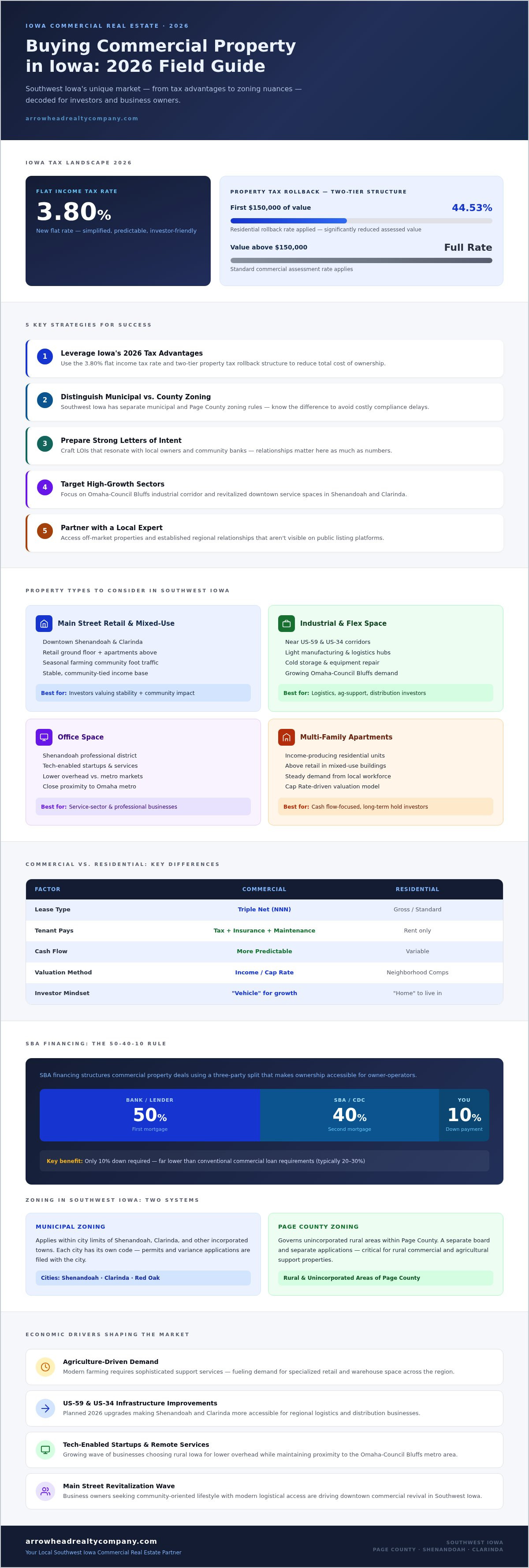
Did you know that in 2026, the first $150,000 of your commercial property's value in Iowa is taxed at a residential rollback rate of just 44.5345%? While the state's tax landscape is favorable with a new 3.80% flat income tax rate, the actual process of buying commercial property in Iowa often feels like a maze of local zoning boards and rural data gaps. You're likely feeling the pressure of finding a space that scales without getting caught in the hidden costs of smaller town regulations or complex financing structures. We understand that uncertainty because we live and work right here in Southwest Iowa.
This guide will help you master the complexities of the Iowa commercial market with expert insights on property types, local zoning, and strategic acquisition. We'll walk you through the nuances of Page County jurisdictions, explain the 50-40-10 rule for SBA financing, and show you how to find a reliable local partner for long-term management. From Shenandoah to Clarinda, you'll gain the clarity needed to secure a property that drives your business growth while keeping your total cost of ownership in check. Let's explore the opportunities waiting in the heart of the Midwest.
Key Takeaways
- Leverage Iowa's 2026 tax landscape to your advantage, specifically the 3.80% flat income tax rate and the beneficial two-tier property tax rollback structure.
- Distinguish between municipal and county zoning requirements in Southwest Iowa to avoid costly delays and ensure your business use is fully compliant.
- Streamline the process of buying commercial property in Iowa by preparing Letters of Intent that resonate with local owners and community banks.
- Focus your search on high-growth sectors like the Omaha-Council Bluffs industrial corridor or revitalized downtown service bays in Shenandoah and Clarinda.
- Gain a competitive edge by partnering with a local expert who provides access to off-market properties and established regional relationships.
The State of Commercial Real Estate in Iowa for 2026
Iowa's commercial market is standing firm in 2026, fueled by a pro-business tax environment that includes a new 3.80% flat income tax rate. This stability makes buying commercial property in Iowa an attractive prospect for those looking to escape the volatility of larger coastal markets. If you are considering buying commercial property in Iowa, you'll find that the synergy between agricultural roots and new industrial corridors creates a unique window of opportunity. While some investors focus solely on big-city industrial parks, Southwest Iowa is seeing a surge in "Main Street" revitalization and light industrial growth. This regional shift is driven by business owners who want the balance of a community-oriented lifestyle and modern logistical access.
When you're evaluating your options, it's helpful to understand the different types of commercial property available. Retail storefronts in Clarinda, office spaces in Shenandoah, industrial warehouses near the I-29 corridor, and multi-family apartments all offer unique advantages. Our connection with the United Country Real Estate network gives you a distinct advantage. We combine national marketing reach with our deep, on-the-ground knowledge of Page County to find opportunities that aren't always visible on public listing sites. This "professional-neighborly" approach ensures you have the data of a national firm with the personal touch of a local partner.
Economic Drivers in Southwest Iowa
The local economy is built on a foundation of agricultural success, but it's diversifying rapidly. Modern farming operations require sophisticated support services, which drives demand for specialized retail and warehouse space. For 2026, planned infrastructure improvements along US-59 and US-34 are making Shenandoah and Clarinda even more accessible for regional logistics and distribution. We're also seeing a rise in service-sector businesses and tech-enabled startups that value the lower overhead of rural Iowa while staying close to the Omaha-Council Bluffs metro area.
Commercial vs. Residential: Key Differences
Investing in a storefront or warehouse is fundamentally different from buying a house. Commercial leases, such as "Triple Net" (NNN) agreements, often place the responsibility for taxes, insurance, and maintenance on the tenant. This provides more predictable cash flow for the owner compared to residential rentals. Valuation also shifts from simple neighborhood comparisons to income-based metrics. In the context of Iowa small-town retail, the "Cap Rate" is the ratio of net operating income to the property's purchase price, representing your expected annual rate of return. While residential buyers look for a "home," commercial investors look for a "vehicle" for business growth. Our team helps you navigate these technical details so you can secure a property that supports your specific financial goals.
Identifying the Right Property Type for Your Investment Goals
Success in the Hawkeye State starts with matching your capital to the specific needs of the local economy. Your strategy for buying commercial property in Iowa should prioritize assets that serve the regional community's daily needs. While metropolitan areas offer standard high-rises, Southwest Iowa excels in specialized property types that bridge the gap between traditional industry and community services. Selecting the right asset class is the first major hurdle, and your choice should align with both your financial capacity and the local economic pulse.
Main Street Retail and Mixed-Use
Downtown Shenandoah and Clarinda offer a professional-neighborly atmosphere that attracts loyal, local consumers. These mixed-use spaces often feature retail on the ground floor with income-producing apartments above. Analyzing foot traffic here isn't just about raw numbers; it's about understanding the seasonal rhythms of a farming community. Check out our Commercial Property for Sale in Shenandoah, Iowa: 2026 Investment Roundup for active listings that match this profile. These properties provide a unique entry point for investors who value stability and community ties.
Industrial and Flex Space Opportunities
Proximity to major transport corridors like US-59 and US-34 makes Southwest Iowa a prime spot for light manufacturing and logistics. There's a growing need for flex space that can handle equipment repairs or cold storage. When you're looking at these sites, you must understand the distinction between light and heavy industrial use. This is where Iowa Code Chapter 335 on county zoning becomes vital. It provides the legal framework for how Page and Fremont counties manage land use outside city limits. Ensuring your property is properly zoned for your intended use is a critical step in the due diligence process when buying commercial property in Iowa.
One often overlooked category is the agricultural-commercial hybrid. These properties, such as large-scale grain storage or specialized equipment dealerships, bridge the gap between traditional farmland and commercial real estate. They require specific loading dock configurations and heavy-duty utility access that standard retail bays don't offer. If you're looking for high-utility assets, these hybrids provide excellent long-term stability. They serve the essential needs of the surrounding agricultural landscape, making them resilient to broader economic shifts.
Professional service hubs are also emerging in Page County. As businesses seek more accessible locations for their employees, local satellite offices for law firms, insurance agencies, and healthcare providers are filling gaps in the market. These office spaces offer a level of convenience and community connection that larger cities simply can't match. Finding the right fit requires a partner who knows every corner of the county. If you're ready to explore these diverse options, take a look at our latest commercial property sales to see what's currently available.
Navigating Zoning and Regulations in Southwest Iowa
Understanding local red tape is the difference between a thriving storefront and a stalled project. When you're buying commercial property in Iowa, you aren't just dealing with state laws; you're navigating the specific quirks of Page County and its municipal neighbors. For 2026, Iowa's tax structure offers a unique advantage for investors. Commercial properties benefit from a two-tier rollback system where the first $150,000 of assessed value is taxed at the residential rate of 44.5345%. Value exceeding that threshold follows the 90.0000% commercial rate. It's a structure that rewards small business owners and helps lower the total cost of ownership from day one.
Beyond taxes, you must account for the real estate transfer tax of $0.80 per $500 increment for any transaction over $500. Environmental due diligence is equally critical. Conducting Phase I and Phase II assessments protects you from future liability, especially when revitalizing older industrial sites. If you're looking at a property that needs significant work, the Iowa Redevelopment Tax Credits program provides vital financial incentives for grayfield and brownfield projects. These credits can significantly offset the costs of bringing a historic or underutilized site back to life.
Due Diligence Checklist for Iowa Buyers
Don't overlook the paperwork that keeps a property profitable. Reviewing existing leases and securing tenant estoppels ensures you know exactly what you're inheriting. You'll also need to verify that utility capacities, specifically water and electrical loads, can handle your specific industrial operations. In Clarinda, the 'Change of Use' permit process requires a formal review by the building official to ensure the new business activity aligns with existing fire and safety codes. This step is essential if you're converting a retail bay into a service-oriented business.
Working with Local Planning Commissions
Building a relationship with local authorities is key to long-term success. If your project requires a variance, you'll need to present your case before the Shenandoah City Council or the local Board of Adjustment. Historic structures in downtown areas often come with specific building code compliance requirements that balance preservation with modern safety. Having local representation at these public hearings is invaluable. We act as your proactive advocate, navigating these meetings with the expertise that only comes from being a seasoned regional leader deeply rooted in the community.
The Step-by-Step Process of Buying Commercial Property in Iowa
Once you've identified a potential site, the transition from browsing to buying commercial property in Iowa requires a methodical approach. It's the point where market data meets financial reality. You'll need to move through several critical phases, from securing the right capital to navigating the final paperwork at the recorder's office. This journey requires patience, but following a structured process ensures you don't overlook the technical details that protect your investment.
Financing Your Iowa Investment
Securing the right loan is the foundation of your acquisition. Many investors utilize the SBA 504 program, which follows a 50-40-10 structure; 50% comes from a conventional lender, up to 40% is financed through an SBA-backed debenture, and you provide a 10% to 15% down payment. As of September 2026, effective rates for 25-year debentures have stabilized around 6.54%. Local lenders in Clarinda often provide more flexibility for small-town retail, as they understand the community's growth potential better than national firms. They'll look closely at your Debt-Service Coverage Ratio (DSCR) to ensure the property's income can comfortably support the debt. If you're looking for a faster path to ownership, consider how real estate auctions can bypass traditional negotiation hurdles.
From Offer to Occupancy
The process usually begins with a Letter of Intent (LOI). This non-binding document outlines the core terms before you commit to a formal Purchase Agreement. Once the agreement is signed, your inspection period begins. In rural commercial buildings, you should prioritize structural integrity, roof age, and environmental safety. Iowa law requires a Groundwater Hazard Statement, which discloses known wells or storage tanks on the parcel. You must also negotiate contingencies for zoning variances or necessary repairs identified during your walkthrough. Title insurance and updated surveys are essential in Southwest Iowa to prevent boundary disputes, especially on older downtown parcels. For a deeper look at alternative acquisition methods, read our Live Real Estate Auctions in Iowa: The Complete 2026 Guide.
Closing the deal involves the final transfer of funds and the filing of the deed with the County Recorder. Expect to pay the state real estate transfer tax of $1.60 per $1,000 of the purchase price, which is required for transactions exceeding $500. The timeline from offer to closing typically spans 45 to 90 days, depending on the complexity of your financing and the depth of your due diligence. If you're ready to start this journey with a partner who knows the local landscape, explore our current commercial property sales to find your next investment.
Why Partner with Arrowhead Realty Company for Your Commercial Search
Choosing the right partner is as vital as choosing the right parcel. When you're buying commercial property in Iowa, you need a team that combines high-level market data with the kind of handshake-integrity found in Southwest Iowa. Arrowhead Realty Company operates as an independently owned franchise of the United Country Real Estate network. This gives our clients the advantage of national marketing reach while maintaining our deep, local roots in Shenandoah and Clarinda. We don't just see buildings; we see the businesses that drive our community's future. Our team excels in facilitating complex agricultural-commercial transactions, ensuring that hybrid properties like grain storage facilities or equipment dealerships are valued and marketed with precision.
The rural market often lacks the transparency found in major metros, making local ties essential. We bridge this gap by providing the specialized knowledge required to navigate Southwest Iowa's unique landscape. From identifying the best "Main Street" service bays to evaluating highway-adjacent industrial sites, we offer a "professional-neighborly" approach that builds immediate trust. We're proactive advocates for your interests, ensuring that every detail of your acquisition aligns with your long-term business goals.
Deep Roots in Shenandoah and Clarinda
Our history of serving the Page County business community allows us to provide expert representation for both buyers and sellers. We often have access to off-market listings that never hit the public portals, giving you a significant edge in a competitive market. Whether you're looking for a retail bay on Main Street or a light industrial site near the highway, we understand the local ordinances and zoning nuances discussed earlier. To get a better sense of how our team supports the community, you can explore our Relocating to Shenandoah, Iowa: Your 2026 Local Real Estate FAQ. We take pride in being a sophisticated navigator for your transaction while remaining a friendly guide to the local landscape.
Modern Tools for Serious Investors
Efficiency is at the heart of what we do. We utilize advanced online real estate auctions alongside traditional brokerage methods to provide a streamlined experience for our clients. These modern platforms allow for transparent, competitive bidding that can move a transaction from listing to closing with remarkable speed. We also provide data-driven market reports that offer clarity in a rural market where data is often sparse. By combining these high-tech tools with proactive, personalized communication, we ensure you're never left wondering about the status of your deal. If you're serious about buying commercial property in Iowa, you deserve a partner who is both traditional in their values and contemporary in their delivery. We're here to help you find and secure results that support your long-term growth.
Secure Your Commercial Future in Southwest Iowa
Iowa's 2026 market presents a unique window for investors who value stability and growth. By understanding the nuances of the two-tier property tax rollback and navigating the specific zoning requirements of Page County, you can position your business for long-term success. Whether you're targeting a Main Street retail bay in Clarinda or an industrial flex space in Shenandoah, the key is balancing hard market data with deep-rooted community relationships. Success here requires a partner who understands the local economic pulse and the technical details of the transition.
Buying commercial property in Iowa doesn't have to be a solo journey. As an independently owned and operated franchise of the United Country Real Estate network, we provide the national reach and modern tools you need alongside the specialized expertise of a local neighbor. We're here to help you find the right asset and navigate every legal and financial hurdle with confidence. If you're ready to take the next step toward securing a high-utility property that supports your business goals, we invite you to View Current Commercial Listings in Southwest Iowa. Let's work together to find an opportunity that fits your vision for 2026 and beyond!
Frequently Asked Questions
Is buying commercial property in Iowa a good investment in 2026?
Buying commercial property in Iowa is a strong choice in 2026 because the state has shifted to a flat 3.80% individual income tax rate. This pro-business move, combined with the expansion of the industrial corridor near Pottawattamie and Mills counties, creates a stable environment for growth. Investors benefit from statutory caps on property tax levy growth, making long-term cash flow more predictable than in neighboring high-tax states. It's an ideal time to secure assets in a resilient Midwest market.
What are the common down payment requirements for Iowa commercial loans?
Down payment requirements usually range from 10% to 25% of the purchase price. If you use an SBA 504 loan, you'll typically need 10% to 15% equity. Conventional financing through local community banks in Page County often requires a 20% to 25% down payment. These lenders prioritize your debt-service coverage ratio to ensure the property generates enough income to support the loan. Always check with your lender for specific terms based on your business type.
How do I find commercial zoning maps for Shenandoah and Clarinda?
You can find these maps by visiting the city hall offices in Shenandoah or Clarinda or by contacting the Page County Planning and Zoning department. It's vital to remember that cities often have extraterritorial jurisdiction that extends up to two miles beyond their borders. We recommend reviewing these maps early in your search to ensure your intended business use aligns with local ordinances. Our team can help you navigate these documents to avoid any regulatory surprises.
What is a 'Triple Net' (NNN) lease and is it common in Iowa?
A Triple Net lease is a structure where the tenant pays the base rent plus their share of property taxes, insurance, and maintenance costs. This arrangement is very common for retail storefronts and industrial warehouses across Southwest Iowa. It's popular with investors because it shifts the burden of rising operating expenses to the tenant. This creates a more stable, hands-off income stream for the owner, which is a key goal for many when buying commercial property in Iowa.
Can I buy commercial property in Iowa through an online auction?
Yes, you can certainly use this modern method to acquire assets. Arrowhead Realty Company provides both live and online real estate auctions through the United Country network. This technology allows you to bid on properties from anywhere, providing a transparent and efficient way to secure results. Auctions are particularly effective for unique commercial assets or agricultural-commercial hybrids where a quick, certain closing is desired by both the buyer and the seller.
What are the environmental due diligence requirements for Iowa commercial land?
Environmental due diligence typically involves a Phase I Environmental Site Assessment to identify potential contamination. If issues are found, a Phase II assessment with soil or water testing may be required. Iowa law also mandates a Groundwater Hazard Statement for every real estate transfer. This document discloses the presence of wells, solid waste disposal sites, or underground storage tanks. Conducting these reviews protects you from future liability and ensures the land is safe for your business.
How long does a typical commercial real estate closing take in Iowa?
A typical commercial closing in Iowa takes between 45 and 90 days. This timeline is longer than a residential sale because it requires more extensive due diligence, including environmental reviews, zoning checks, and specialized appraisals. Financing through the SBA or local banks also involves detailed underwriting of the business's financials. We work closely with all parties to keep the momentum moving forward, ensuring that every legal and financial requirement is met before the deed is filed.
Why should I use a local broker like Arrowhead Realty instead of a national firm?
Local brokers offer deep-rooted community ties and neighborhood-level insights that national firms simply can't match. We understand the specific rhythms of the Shenandoah and Clarinda markets, including off-market opportunities and local zoning nuances. As an independently owned franchise, we combine this professional-neighborly expertise with the national marketing power of United Country Real Estate. This ensures you get sophisticated representation while working with a partner who is a proactive advocate for your success in the local landscape.


